
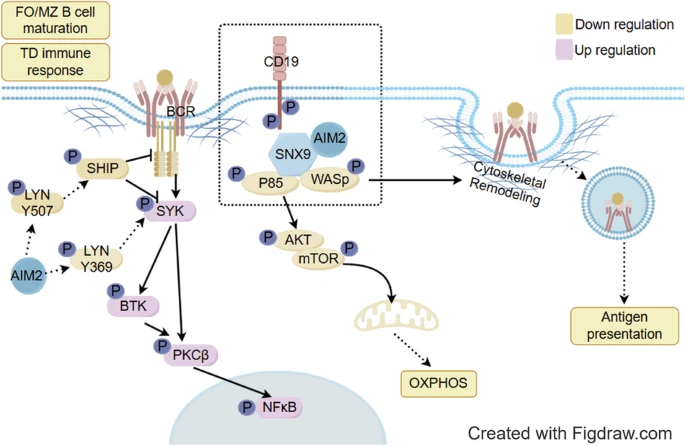
This week, the research team led by Professor Chao-Hong Liu from the Basic Medical School of Huazhong University of Science and Technology published a groundbreaking paper titled “AIM2 positively regulates B cell activation and function through the SNX9-PI3K-WASP axis” in Nature’s series journal Cell Death & Differentiation (Impact Factor 15.4).
This seminal work fundamentally reshapes our understanding of AIM2 (Absent in Melanoma 2). It reveals that beyond its classic role as an innate immune “sensor,” AIM2 is also an indispensable and precise “regulator” within adaptive immune B cells. Employing a systematic approach—including a B cell-specific AIM2 knockout mouse model, multi-omics analysis, and molecular interaction validation—the team elucidated, AIM2 exerts dual regulatory effects on BCR signaling transduction by positively regulating the PI3K-AKT signaling axis and negatively regulating the BTK-NFκB signaling axis.
Furthermore, AIM2 is involved in the endocytosis of BCR and CD19 and the subsequent antigen uptake and presentation processes via SNX9-WASP interaction.
The GenoLab M platform from Genemind provided high-quality RNA-seq data for this study. This data enabled the precise analysis of transcriptional profile changes in B cells following AIM2 loss, supplying critical evidence for the subsequent mechanistic investigations.