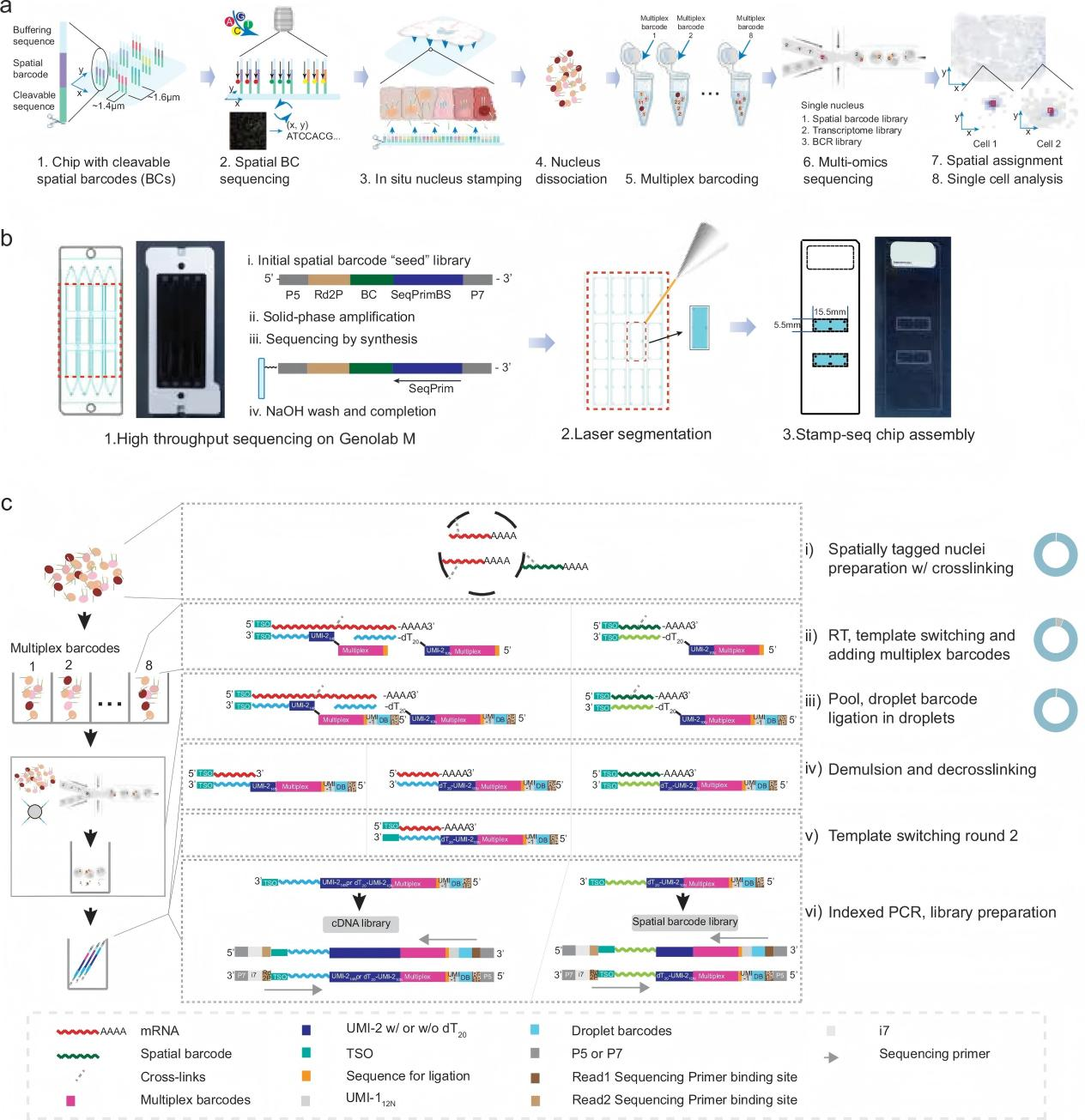
On February 5th, research teams led by Researcher Chenxi Tian from the Beijing Institute of Genomics, Chinese Academy of Sciences, and Director Yongchang Zhang from the Furong Laboratory, Central South University, in collaboration with R&D teams from SeekGene BioSciences and GeneMind Biosciences, have published a research paper titled "Integrating single-nucleus barcoding with spatial transcriptomics via Stamp-seq to reveal immunotherapy response-enhancing functional modules in NSCLC" in the well-known journal Cell Discovery (IF 12.5).
Spatial transcriptomic profiling enables transcript localization but is limited by cell boundary inference, low gene detection, and high cost, hampering unambiguous cell state assignment.
Key findings:
1.Stamp-seq uses custom high-density DNA sequencing chips with restriction enzyme-cleavable spatial barcodes (1.6 μm spacing) to achieve true single-cell resolution and precise spatial mapping (~4 μm error) at reduced cost.
2.Applied to non-small cell lung carcinoma (NSCLC), Stamp-seq identified a distinct IGHG1⁺ plasma cell-enriched community within chemoimmunotherapy-responsive ecosystems.
3.Spatially resolved BCR clonotypes revealed the spatiotemporal trajectory of IGHG1⁺ plasma cells, originating from tertiary lymphoid structures or vasculature, migrating through apCAF-rich survival niches, and contacting tumor cells.
4.The IGHG1⁺ plasma cell niche serves as a superior prognostic biomarker for chemoimmunotherapy response compared to existing markers.
These findings indicate that spatial communities containing fibroblasts have a pleiotropic effect on multiple elements of the TME to modulate the treatment response. These findings also indicate that methods designed to delineate spatially resolved cellular states promote the development of diagnostic and prognostic modules for human diseases.
Dr. Lei Liu from GeneMind and team member Zhao Li, leveraging the SURFSpace spatial chip developed based on the GenoLab M sequencing platform, provided strong support for the development of Stamp-seq technology. Learn more about the platform here: https://zmsw.szmynet.net/NGS-Sequencers/252.html